
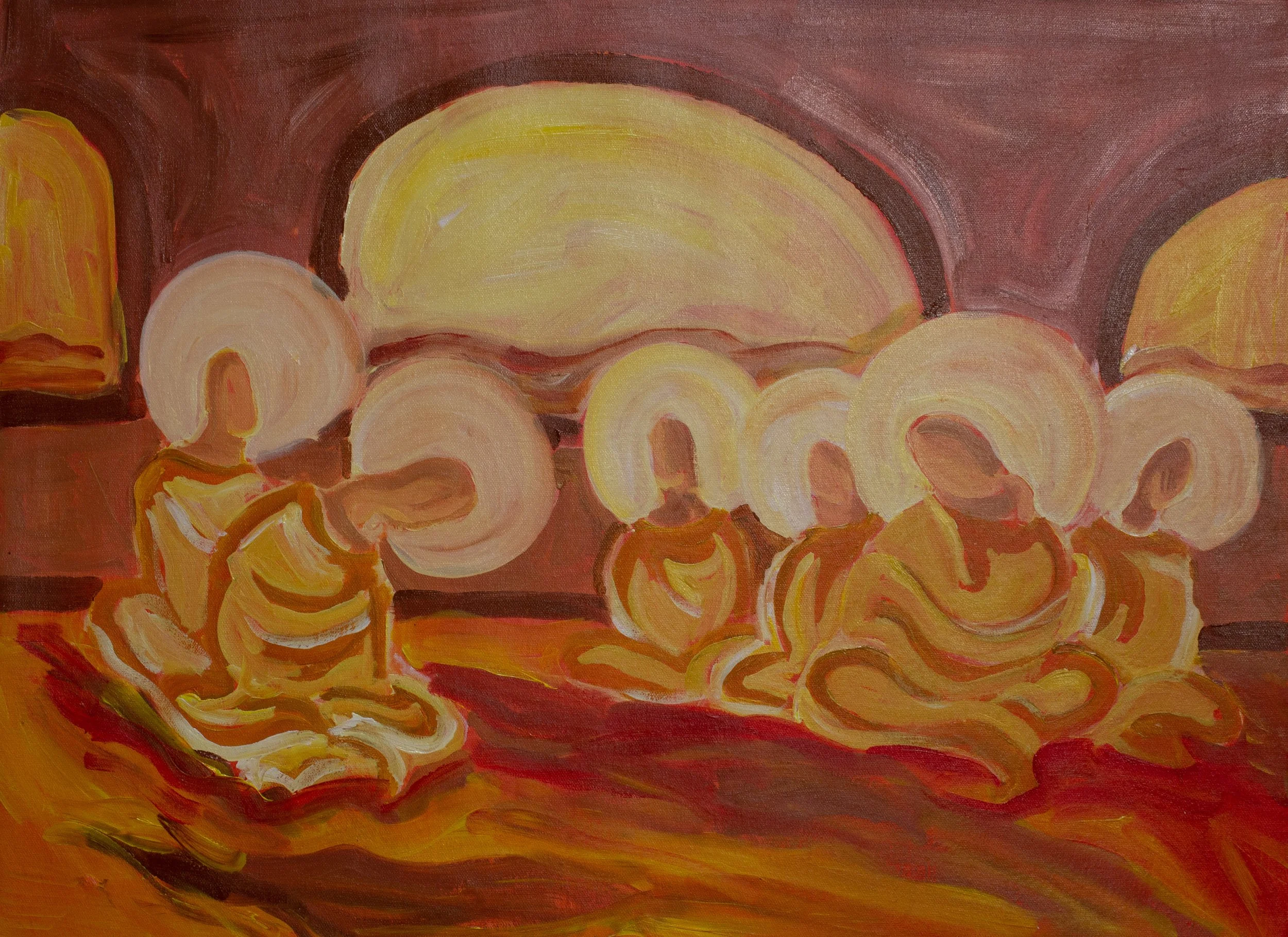
Huỳnh Công Nhớ, The Prayer (Nguyện Cầu) #2, acrylic on canvas, 60 x 80 cm, 2023. Courtesy of Galerie Bao
At the Crossroads of Unrealities
by Linh Lê*
…where scenes from lives in the distant past and the near future become entangled with those of the mind, as two worlds that seem far apart at first begin, slowly, to collide. In their first-ever duo exhibition, realised through a joint effort between Galerie BAO and RUCI Arts Space, Đà Nẵng-based artist and filmmaker Huỳnh Công Nhớ and Yogyakarta-based artist Pecut Sumantri turn to the quotidian—everyday people engaged in everyday activities—to open up a space of enquiry into faith, belief, and the human condition.
In the sober light that reigns across Huỳnh Công Nhớ’s paintings, people—often faceless, dressed in earthy-toned clothing—engage in the act of praying. Above their tilting heads hover bright discs, or halos. Sometimes these faceless figures cluster together inside modest chapels; elsewhere, they sit in open, mountainous landscapes of the coastal region he calls home, their gestures repeating as if part of a shared choreography. A familiar symbol in classical religious paintings, the halo is traditionally used to determine the holiness of a figure, a demarcation between the sacred and the profane. In Huỳnh’s paintings, however, the halo seems to be quietly desacralised: it marks fleeting moments when a person realises that they truly exist—while praying, sleeping, thinking, or simply talking with others. Rather than separating the figures, the halos bind and strengthen their collective presence. At the same time, each halo creates what Gilles Deleuze calls a “round area” in painting: a circular zone that isolates the figure from everything around it—in this case, from the landscape or architecture—so that this brief, self-aware existence can be concentrated and held, suspended slightly outside ordinary time.
Such depictions perhaps owe something to Huỳnh’s background as a filmmaker, who thinks through the frame and the act of framing. Coming to painting from cinema, he approaches each canvas as though it were a still cut from an unseen film: a close-up of a cluster of cacti lying on the ground; a zoom-in on a hat, perhaps mid-conversation between two soldiers; a god’s-eye, wide-angled view of a street intersection where human presence becomes arbitrary, if not caricatured. Rendered in an apparently child-like manner with harsh, deliberately crude brushstrokes, these scenes—drawn from Huỳnh’s memories, observations and ideas for future films—are at once direct and personal, yet strangely estranged. As time goes by within these images, the light seems to grow even brighter, an almost glaring clarity pushing scenes and objects out of their familiar space-time, nudging the everyday towards a quiet unreality.
Meanwhile, a foggy dream drapes over the figures in Pecut Sumantri’s works. The atmosphere is so dense that light can no longer pass through; instead, it stalls and breaks apart into blotches of colour. His figures, out of focus and fleshy, are observed and exposed in their most intimate states, thick with emotional rawness. As if they were test subjects in a psychological experiment, every movement and expression seems carefully captured and scrutinised. What was once a stylistic device—a clean, decisive drag of the brush from one side of the canvas to the other, used to experiment with the linearity of time—now dissolves into a directionless blurriness that clouds the entire surface. The effect recalls the tradition of Western old master painting, where techniques such as sfumato, the softening of edges, were used to evoke the ethereal, enigmatic presence of a figure in space. As in cinema, blur also signals a tension between closeness and concealment, intimacy and distance, a character’s faulty vision or dissociation from reality. As a result, Sumantri situates viewers in a feigned proximity to his figures—close enough to see them in their vulnerable existence, yet still held at arm’s length.
Though they share a commitment to the everyday, Huỳnh Công Nhớ and Pecut Sumantri—both self-taught—come to painting from markedly different backgrounds, and as a result respond to the medium in almost opposite ways. Having received formal training in philosophy, Sumantri often treats painting as a way of slowing down inner turbulence. His tendency to push towards abstraction is a quiet revolt against the realism he grew up seeing, a tradition in which art is expected to mirror the visible world in painstaking detail. For Huỳnh, by contrast, realism and its apparent straightforwardness become an intentional strategy—a way to hold on to his own naïveté and art-brut sensibility. Where Sumantri demonstrates a finely tuned command of light and colour, Huỳnh leans into rough edges, allowing awkward lines and uneven surfaces to remain. Yet in both, scenes of daily life and its people occupy centre stage. Coming from different histories, cultures and socio-political contexts, their paintings nonetheless open a shared platform in which ordinary lives—and their often-neglected struggles—are given room to appear, to persist, and to be taken seriously. Together, their works prompt viewers to reflect on what it means to go on living and believing in what increasingly feels like an age of unreason—an era where uncertainty and precarity are loud and clear, while trust and belief are continually muffled and eroded.
—
* Linh Lê is an independent curator and researcher from Ho Chi Minh City. Her current curatorial and research endeavour explores the (im)possibilities of the archive, as well the potential encounters between performance-making and exhibition-making. With the local art community at the centre of her work, Linh also expands her curatorial scope to publishing, discussion, workshop, and teaching. Some of her past projects include CáRô—an arts education programme for local youth (Ho Chi Minh City, 2020-21); Măng Ta—a self-initiated journal on Vietnamese arts and culture (2020-pending). Some of her past curatorial projects include ‘Chợt Mộng Tan’ (2022, Á Space); ‘Dept. Of Speculation’ (2022, Galerie Quynh); ‘All Aboard’ (2023, Galerie Quynh) and ’Soon The Time Will Come’ (2023, Á Space). She is a research fellow of ArtsEquator’s Southeast Asian Arts Censorship Database project, a Curatorial Board member of Á Space — an independent art space founded in 2018 in Long Bien District, Hanoi.